JULY 6 8:02 PM. Edinburgh.
This is more like it. This is a proper city.
“It’s an Englishman’s idea of a Scottish capital,” said the bus driver when he was slagging it off. This says more about either group than he may realize.
Edinburgh ticks all the boxes. The architecture is more somewhat more restrained and sedate, with the occasional insanely filigreed monument.
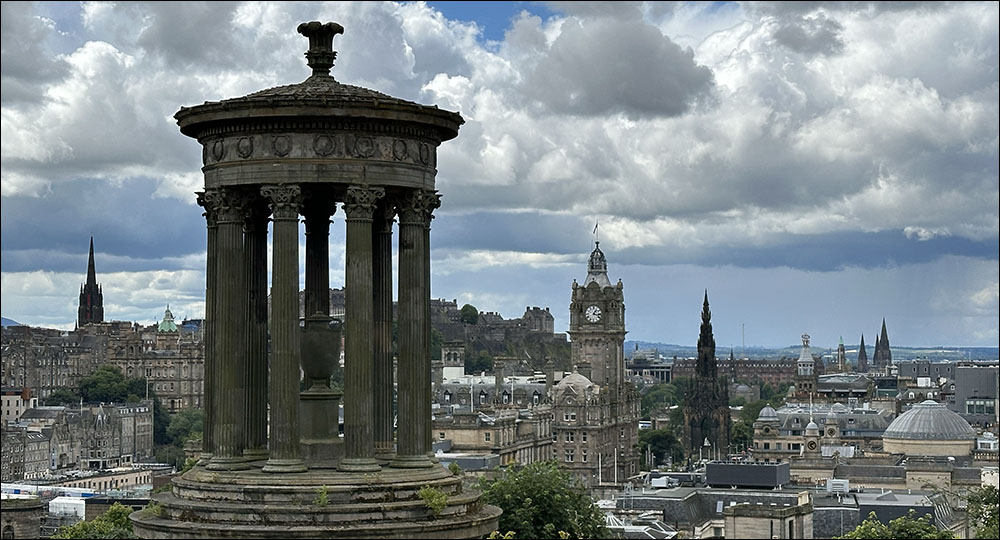
First stop: Calton Hill, aka the hill with all the old stuff on it.
The object on the banner above is a monument to an Enlightenment Guy, and hence is suitably classical and intellectual. There was an observatory up here, and while the dome is still there - its gears and teeth and rotating mechanism intact, like something out of Myst - it has been filled with precious little bits of modern art, which of course asks us to interrogate the relationship between - are you ready? TIME AND SPACE. Even better, time and space “according to the theories of (some dude, can’t recall.)
There is a strange half-finished structure, and you think its incompleteness is intentional, standing for some job yet undone.
But what is it for? It is the National Monument of Scotland, the memorial for the soldiers and sailors who died in the Napoleonic Wars, which was somehow surprising. That was so very long ago. But here it is. Stark and unmodified as the day it was erected. You think: two thousand years from now, will it have fallen? Will its ruins be a tourist attraction? Will they rebuild it according to the wishes of the Lost Ancients? Who was this Napoleon, anyway?
They’ll probably know. After all, we know of Caesar.
Anyway, its incompleteness gives it the quality of an abstraction, which would be quite a modern idea for the time. Why, I could write an entire paper on the Enlightment ideas as manifested by an unfinished building, how it symbolizes man's search for refinement and completion, and . . .
It was designed during 1823–6 by Charles Robert Cockerell and William Henry Playfair and is modeled upon the Parthenon in Athens. Construction started in 1826 and, due to the lack of funds, was left unfinished in 1829. This circumstance gave rise to various nicknames such as "Scotland's Folly", "Edinburgh's Disgrace", "the Pride and Poverty of Scotland" and "Edinburgh's Folly”.
NEVERMIND
There was a Nelson’s monument, designed by a fellow named Robert Burn. No doubt he tired of the jokes. No I don't have a twin by the same name which would mean we are a poet when get together ha ha good one tho.
From there we wandered westward, looking for a place to sit and eat a panini. Marveled at the Walter Scott memorial, claimed as the world's largest memorial for a writer. Seems about right.
We headed up into the New Town, which was built along the enlightened lines - a rational grid with long “palace facades” that tied blocks of apartments together. One of them was restored to its original state, and why yes we would like to tour.
The former home of Mr. Lamont, a landed gentleman who apparently sold off his various properties to fund his indolent society lifestyle. Another visitor either had permission or decided the risk was worth it:
In one room an elderly docent asked where we were from, her first question in pointing us to something specific in the room. “Minnesota” presented a challenge. She settled on telling us that if we were French, we would enjoy this newspaper account of the fall of the Bastille. They had original papers, and since I know a bit about the newspapers of the period we had a nice chat about that, exchanging observations about the layout, the precision (justified right, hand set, 1789!)
At some point in the main salon I saw a picture of a temple by a stream, read the notes about how it was a nearby structure by the river, and thought “wife’s going to hear about this SOMEHOW and we’re destined to go find it.” Which is what happened. SOMEHOW. We headed up in the wrong direction, ended up in Stockbridge, had a coffee, then set out to find it.
This is late 1880s. Sherlock time. It strums such a broad deep chord. Why? English confidence and solidity and good intentions, a solid Anglo future built on these noble works.
Like I said, everything here just feels like I am a human tuning fork struck once and resonating all day.
Where's the modern world? Elsewhere.
Then the rain came as we were trying to find supper. We made the mistake of going down Rose, which was mostly pubs for the people watching soccer, piled inside in humid human masses. Eventually ended up at a place I’d seen at the start of our peregrinations, and it was snug and civilized. It's on the left, the white portion of the building.
This was our street. Waterloo. Swing around and you'll see the 19th century without a tall glass structure in sight.
We found a pub that said there’d be live music. Not packed. Not mad. The singer came in with his dog, Poppy, who was worried every time he left to get his gear.
I had a bit of a genial disputation with the barkeep, who disparaged all my whisky and whiskey choices, especially the latter, and I gathered I was in the presence of a whisky snob. He recommended something I finally tried, which had a middle note of soap.
Day one concluded. My new favorite city.
|